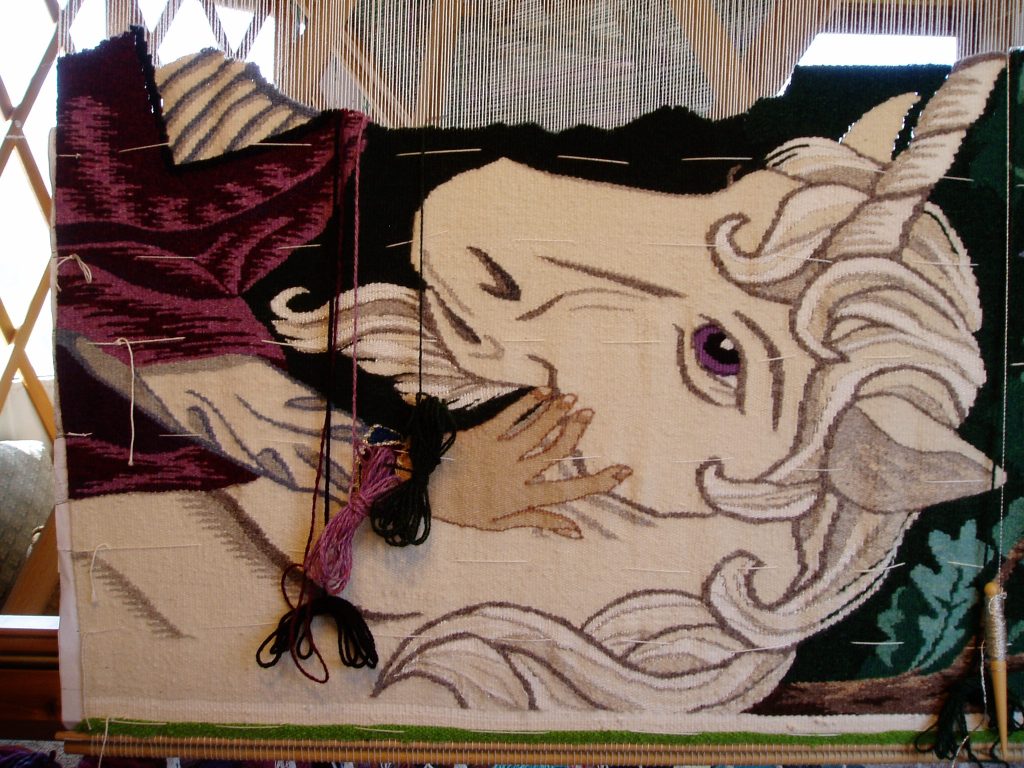
Unicorns killed for the sake of sport? Maidens used as bait to lure these magical creatures to their death? Is your skin crawling yet?
Mine was, as I stood before the impressive tapestries from France I had waited so long to see in anything but the pages of books.
So, I decided to offer a shift to the story and create a portal to a “what if” ending that invited the viewer to choose. Will you join me in crafting a new twist to this tale? Or will you turn these characters in and give them the same fate they have suffered for more than 500 years?
The stories of our own lives can shift on an instant—a chance meeting, a car accident, an unexpected diagnosis, and epiphany. Where, in this saga of hunting unicorns would be that magical portal for the shift to occur?
When you enter the tapestry room at the Cloisters Museum in New York, it can be easy to miss a key panel in the story. In fact, so little remains, some scholars dismiss this as being a part of the original set at all. But stylistically and compositionally, I can see the overlap, and I agree with art historian Margaret Freeman that this is a piece of the original because it makes sense with the ancient tales repeated over and over across Europe and the Middle East.
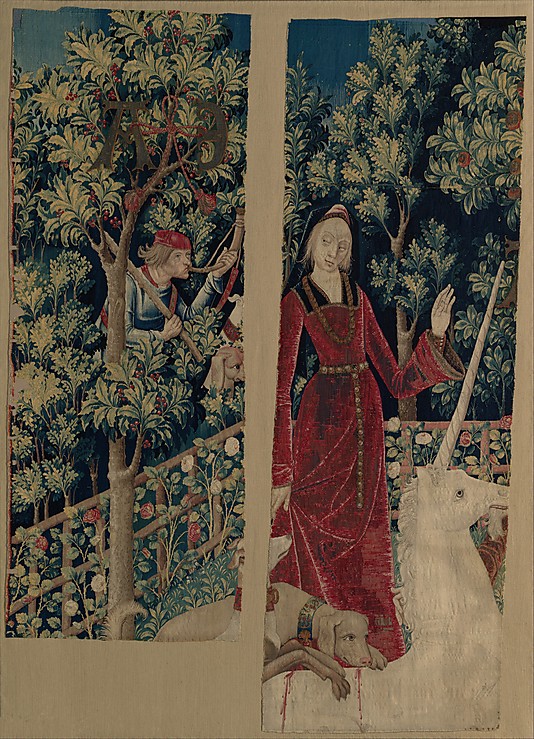
The unicorn cannot be taken by force. He can only be taken by “guile.”
It’s an interesting word—guile. A clever but dishonest means of tricking someone. In this case, the unicorn thinks he is safe with the comely maiden, resting in her lap. But he’s not, for the hounds soon pounce upon his snowy flanks, and the hunters blare their horns, and he is surrounded. Too entranced and surprised to counter-attack, the disarmed creature is slain for the glory of the laird.
And who is the instrument of this guile? The maiden as bait.
The panel that shows this scene sits above the entry door into the tapestry room, with only two fragments remaining. They depict a handmaiden signaling to a trumpeter hidden in the trees, and the unicorn entranced with the dogs upon his back. But this maiden in the rose garden has been lost to the disasters of the French Revolution, except for a piece of her sleeve and her dexterous fingers in the unicorn’s curling mane.
I looked a long time at these surviving pieces, and I knew it had to be her. We have no surviving face, so there was room to imagine—to create a new maiden for this story. And, above all, to give her agency.
While the social expectancy was for medieval women to be demur and submissive, we have plenty of surviving examples of plucky ladies who were willing to kick butt—from the obvious examples of Joan of Arc defending her country to the hold-the-fort women of spunk like Margaret of Anjou. We have “I’ll say what I want” women in Chaucer’s Canterbury Tales, outspoken poets like Christine de Pisan, queens who wield incredible influence like Eleanor of Aquitaine, and women who led their own feministic societies within the church like Hildegard of Bingen. Even ballad culture supplies us with often unnamed women who outsmart men—usually in defense of their maidenhead or to thwart murder attempts. Demur was not for everyone.
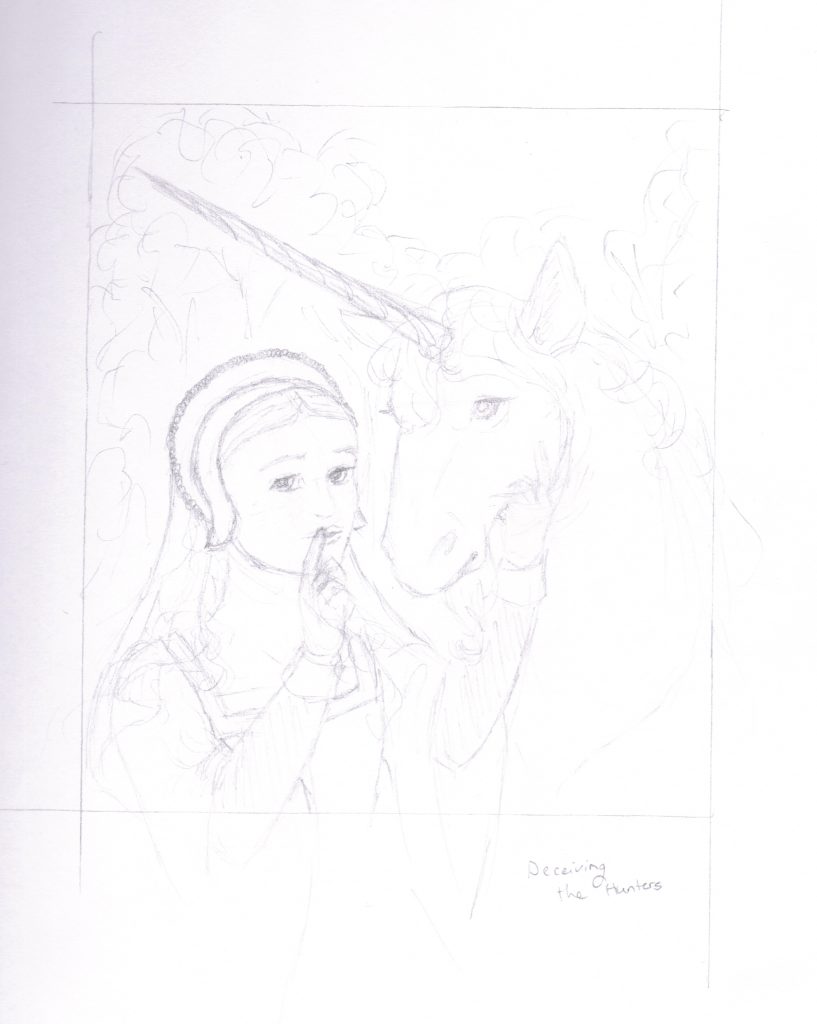
But my maiden of agency for this alternative narrative would be no Joan of Arc. She still had to be chosen as the “bait” by the powerful men of the story. They thought she would dutifully play her part, then they could have their booty. But once in the midst of this situation, she resolves otherwise. That could be any of us in the moment of awakening to being used within a struggle for power. She could be me or you.
We could sit up and say, “How about no.”
So, instead of giving the unicorn over to the men, in my retelling, she is going to lead the unicorn away to safety.
Where would that be? And then what might happen to her? Would she resume her customary role within society, hoping not to be noticed and blend in? Would not that risk the wrath of the thwarted men more powerful than she?
Or would she also run away with the unicorn, to an uncertain life beyond what she has known? Would they become allies on a new adventure?
First, I needed to find the inspiration for just the right lady for this narrative to draw and weave the story shifting into being—then refuse to give up when the inner critic reared its head right in the middle of the process. Designing and weaving a tapestry of scale is slow and methodical, with attention to each detail of leaf, fold of fabric, or lock of hair, a journey that would command my loom and imagination for seven years.